本篇目录 / Contents
- Don't Complete Me: From Evangelion to Human Surrender
- Instrumentality, Intimacy, and the Ethics of Knowing When to Stop
- 1. The Most Frightening Thing Is Not Loneliness. It Is Someone Curing It for You.
- 2. Evangelion's Cockpit Did Not Disappear. It Became Every Request to “Keep Going.”
- 3. Even Failure Can Be Put to Work: You Break Down, and the Camera Keeps Rolling
- 4. Intimacy Is Not Mutual Completion. Do Not Use Me as a Mirror.
- 5. Even Your Blank Stare Can Be Edited into Content
- 6. The White Fabric Does Not Block the Gaze. It Makes the Gaze Hurt More.
- 7. The Credits' Cruelest Cut: The Film Finally Stops
- 8. To Surrender Is to Stop Telling the Whole Person
- 9. For Those Who Still Remember Evangelion: The Cockpit Has Dispersed
- Watch and Continue
- Evidence Boundary
Don't Complete Me: From Evangelion to Human Surrender
Instrumentality, Intimacy, and the Ethics of Knowing When to Stop
If the words “I understand you” have begun to frighten you in recent years, this essay may be for you.
The most suffocating thing is not always that no one understands you.
Sometimes it is the opposite.
Someone understands you too quickly.
Before you have made sense of yourself, they have summarized you.
You fall silent, and they decide that you are “really just avoiding the issue.”
You cannot find the words, and they ask gently: “Do you need me to speak for you?”
None of this sounds cruel.
It may even sound considerate.
But care is one of the easiest places in which a person can be carried away.
So I want to put one sentence at the beginning:
Don't complete me.
This does not mean “leave me alone.”
It does not mean that no one could ever understand me.
Nor is it a glamorous pose of solitude.
It opposes something subtler: the world’s reflex to finish a person the moment they break, hesitate, lose their words, or fail to explain themselves. Give them an interpretation. Sum them up. Help them express themselves. Tell them what they were really thinking, what they actually need, what kind of story their pain belongs to, and where their experience is supposed to lead.
Completion does not always arrive looking like violence.
Often it looks like understanding.
Like concern.
Like “I get you.”
Like “Do you need me to speak for you?”
This is why returning to Neon Genesis Evangelion—Evangelion for short—today cannot be an exercise in nostalgia alone. We cannot stop at the mecha, the Angels, the red sea, or the streams of consciousness. Nor is it enough to say, “Young people in East Asia are all in pain.” That sentence is too convenient—so convenient that it has almost no danger left in it.
The more dangerous question is this:
When a person cannot become a complete self, what will their era use to process them?
Evangelion answers loudly: the cockpit, synchronization, institutional command, the father’s gaze, the Human Instrumentality Project.
Human Surrender (Shoot Self with You) answers at point-blank range: lighting positions, rehearsal, camera, audience, white fabric, backstage space, names, acknowledgments, rewatching, and the archive.
It does not push you into a gigantic machine.
It does something harsher.
It lets you discover that the machine has already dispersed into everyday life.
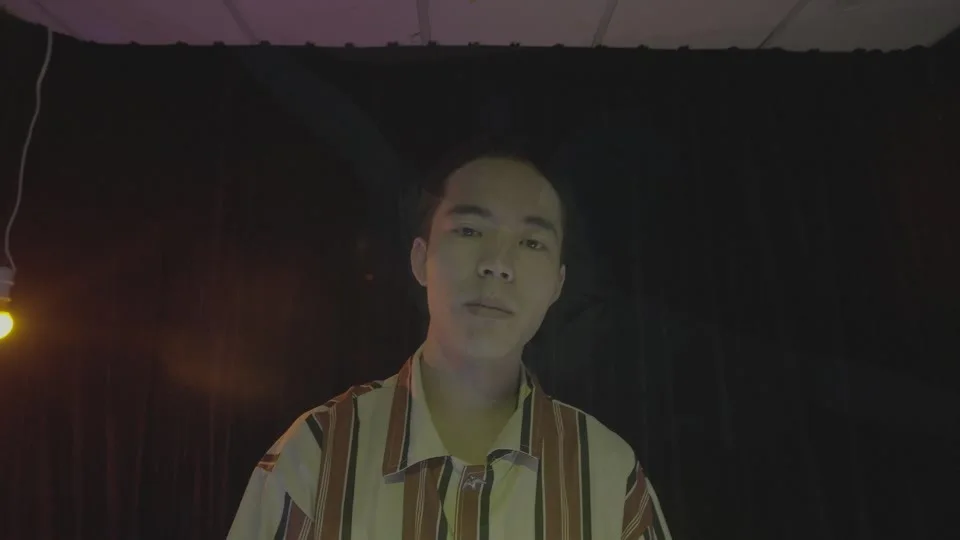
The face is close, but the lamp and dark stage keep the conditions of looking visible. Film still from Shoot Self with You / Human Surrender.
1. The Most Frightening Thing Is Not Loneliness. It Is Someone Curing It for You.
Looking back, the most terrifying thing about Evangelion was never simply “a boy pilots a giant machine and fights monsters.”
Its enduring wound is that a boy has not yet learned how to be a person, while the world has already placed its full weight in his hands.
He does not want to enter.
But if he refuses, it is as though he forfeits the right to exist.
If he enters, the machine uses him.
If he runs, the world returns him to an even deeper shame.
That is why Evangelion has not become obsolete. It takes a problem from one adolescent’s room and enlarges it until it becomes a problem for humanity:
If people are always divided by boundaries; if they can never fully understand one another; if they will always misread, wound, and avoid each other; if they keep longing for closeness and fearing it at the same time—
why not abolish the boundaries?
This is the terrible seduction of Instrumentality: the fantasy of being completed.
It appears to cure loneliness.
What it actually does is absorb loneliness into a larger whole.
Distance between people hurts, so make distance disappear.
The fact that each person has a boundary hurts, so make the boundaries disappear.
The fact that I cannot become a complete self hurts, so give me to a larger “we.”
Instrumentality’s deepest violence lies here. It does not kill the human being. It solves the difficulty of being human on the human being’s behalf.
It says: you will never be lonely again.
The price is that you will no longer need to be you.
This resembles too many relationships today.
The other person may have no desire to hurt you.
They may simply want too badly to end your pain—to make you explain yourself, to make you “better.”
But sometimes what a person needs is not to be cured.
First, they need not to be carried away.
2. Evangelion's Cockpit Did Not Disappear. It Became Every Request to “Keep Going.”
Human Surrender does not picture this terror as a red ocean or encase it in an apocalypse.
It is colder, and much closer.
It dismantles the machine and hides the parts in ordinary life.
This is not an after-the-fact attempt to inflate the film’s importance. In P4 Theater’s early public writing on Human Surrender, one stark claim came first: cinema seemed to be the last road left. By the time of The Last Rehearsal, the work was described as neither theater nor film, but “a thing.”
That shift matters.
It tells us that Human Surrender was never content to remain a work safely classified as cinema. It needs film because film can preserve light, bodies, sound, time, and the look of those who arrive later. Yet it continually spills beyond film into rehearsal, public performance, writing, post-performance echoes, a decade-long archive, and the relations produced by repeated viewing.
We should therefore ask more than “What story does it tell?”
We should ask: what kind of event does it produce? How does that event process a person through light, position, audience, sound, material, and archive?
A complete interior self does not enter the film first. The positions have already been prepared: where the light will fall, where the body will stand, where the camera will look from, who will be summoned, who will be left behind, who will become visible to an audience.
Here, a person does not emerge naturally from the depths of an interior life.
The person is developed—brought into view by the pressure of conditions.
This is where Human Surrender goes deeper than the idea of a post-pandemic Evangelion. It does not transplant Evangelion's enormous machine into a Chinese setting. It recognizes that the machine no longer needs to resemble a machine.
It can be a rehearsal.
A prompt.
A camera left running.
An audience’s silence.
A list of names in the credits.
It can be an entirely reasonable request to continue:
Keep speaking.
Keep performing.
Keep explaining.
Keep being watched.
Keep being preserved.
This is the condition that presses most intimately upon our generation.
We may not be forced into a cockpit, but we have long since been placed in positions prepared for us. Jobs, relationships, platforms, cameras, chat histories, debriefs, documents, screenshots, archives, and public judgment have all reserved slots in advance.
Often, you do not choose to enter the event.
You wake to find it already operating around you.
3. Even Failure Can Be Put to Work: You Break Down, and the Camera Keeps Rolling
An ordinary film cuts out failure.
Human Surrender does the opposite.
It preserves failure.
The inability to perform: preserved.
Getting stuck: preserved.
Missing a cue: preserved.
Silence: preserved.
Spacing out: preserved.
There is something precious in this. What truly happens is rarely smooth. Speech breaks. People hide, improvise excuses, suddenly want a cigarette, fail to finish a sentence, or use the body to delay what language cannot bear.
But the terror of Human Surrender lies here as well. Once failure has been preserved, it does not automatically become free.
Failure becomes material for the next layer.
When a sentence can no longer move, the body takes over.
When the body cannot bear it, material takes over.
When the material overheats, sound takes over.
When sound recedes, backstage space takes over.
When backstage space still will not fall quiet, the archive takes over.
This is not chaos.
It is the film’s sharpest intelligence.
Every breakdown becomes an entrance into another medium.
But if everything can always continue—if every failure can be converted into new material—when is a person finally allowed to stop?
This is what makes Human Surrender more deserving of attention than so much art that merely calls itself cruel.
The film does not only know how to demand.
Gradually, it forces another question into view: when cinema becomes too good at continuing, too good at preserving, too good at making failure meaningful, does cinema itself possess the ability to stop?
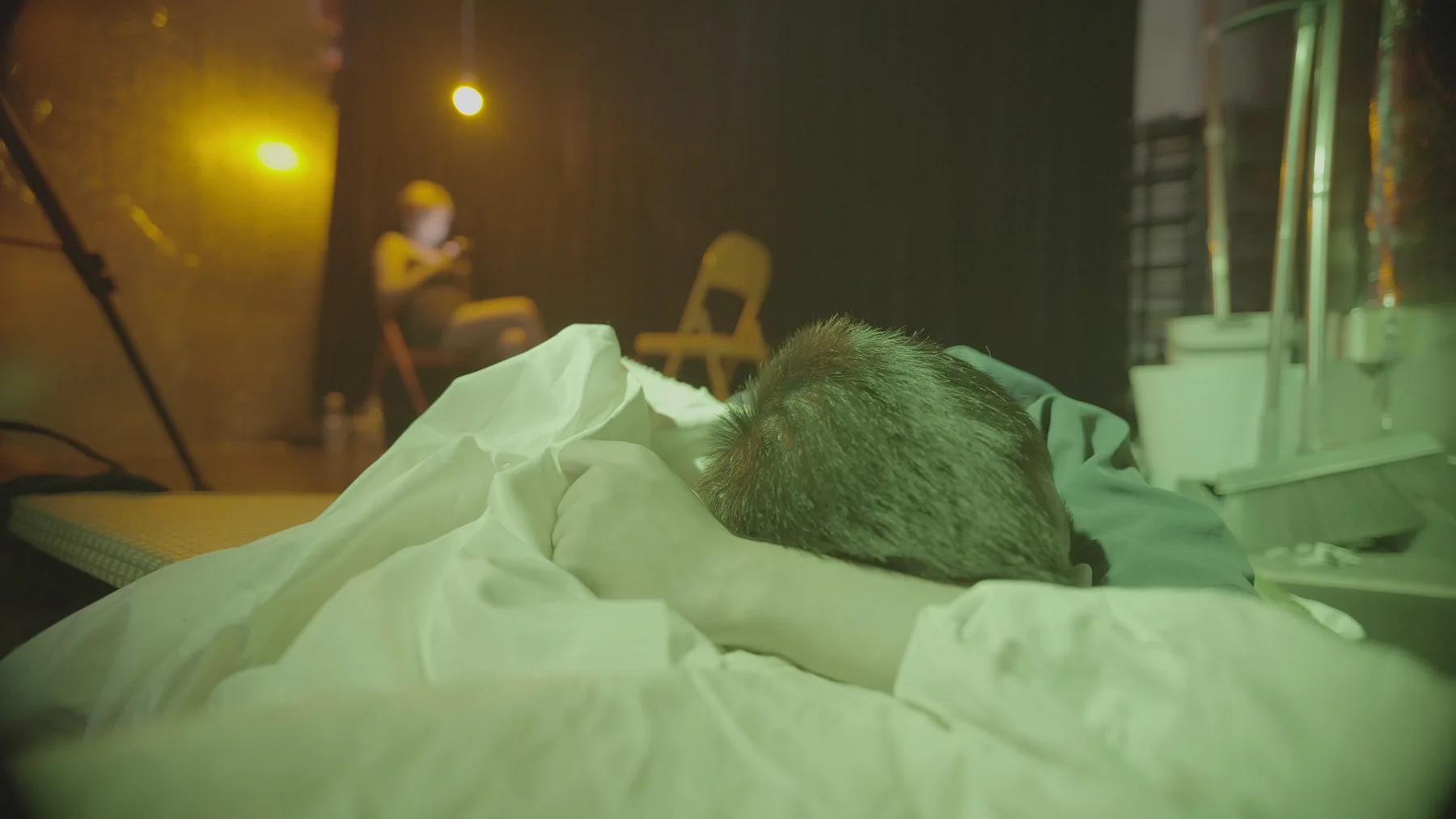
The image preserves a withdrawal without explaining it. Film still from Shoot Self with You / Human Surrender.
4. Intimacy Is Not Mutual Completion. Do Not Use Me as a Mirror.
Many viewers will see Human Surrender as the collapse of an intimate relationship.
That is not wrong, but it is not enough.
The film is not merely about “I love you, but you do not understand me.” Its deeper structure is this: I try to use you to confirm that I exist, but your eyes, your voice, your body, and your response cannot fully acknowledge receipt of me.
One exchange is quiet and devastating.
Someone repeatedly insists that they can be alone.
Then, while saying it, they ask:
“Are you there?”
The other person answers:
“I’m here.”
This is not ordinary dependence, still less a simple plea for reassurance. It exposes the most fragile structure inside independence:
I want to be alone.
But I need to know that you have not vanished completely.
I want to prove that I can exist by myself.
But the statement still needs someone to hear it.
I can be alone—provided that “you” remain somewhere.
Human Surrender does not romanticize brokenness, nor does it argue that people should remain entangled forever. It simply films an honest truth: being “alone” often does not mean living without relation. It means fighting for a small area in which to breathe from within a relation.
The eyes are crueler still.
We search for ourselves in the eyes of another person.
We often imagine intimacy as the experience of seeing ourselves reflected there. In Human Surrender, the eye is no longer a mirror. The closer we move, the less it can return a complete self. The body has not disappeared. The face, hands, and voice remain. Yet the “I” that hoped to be confirmed in the other person’s eyes has vanished.
This is not the petty unhappiness of feeling misunderstood.
The system for acknowledging receipt has broken.
You cannot turn another person into the mirror that returns you to yourself.
Nor can you treat your understanding as proof that the other person is finally whole.
“Don't complete me” now acquires a deeper meaning:
Do not make your eyes my destination.
Do not make your understanding my boundary.
Do not assume that because you have seen me, you can hand me back to myself.
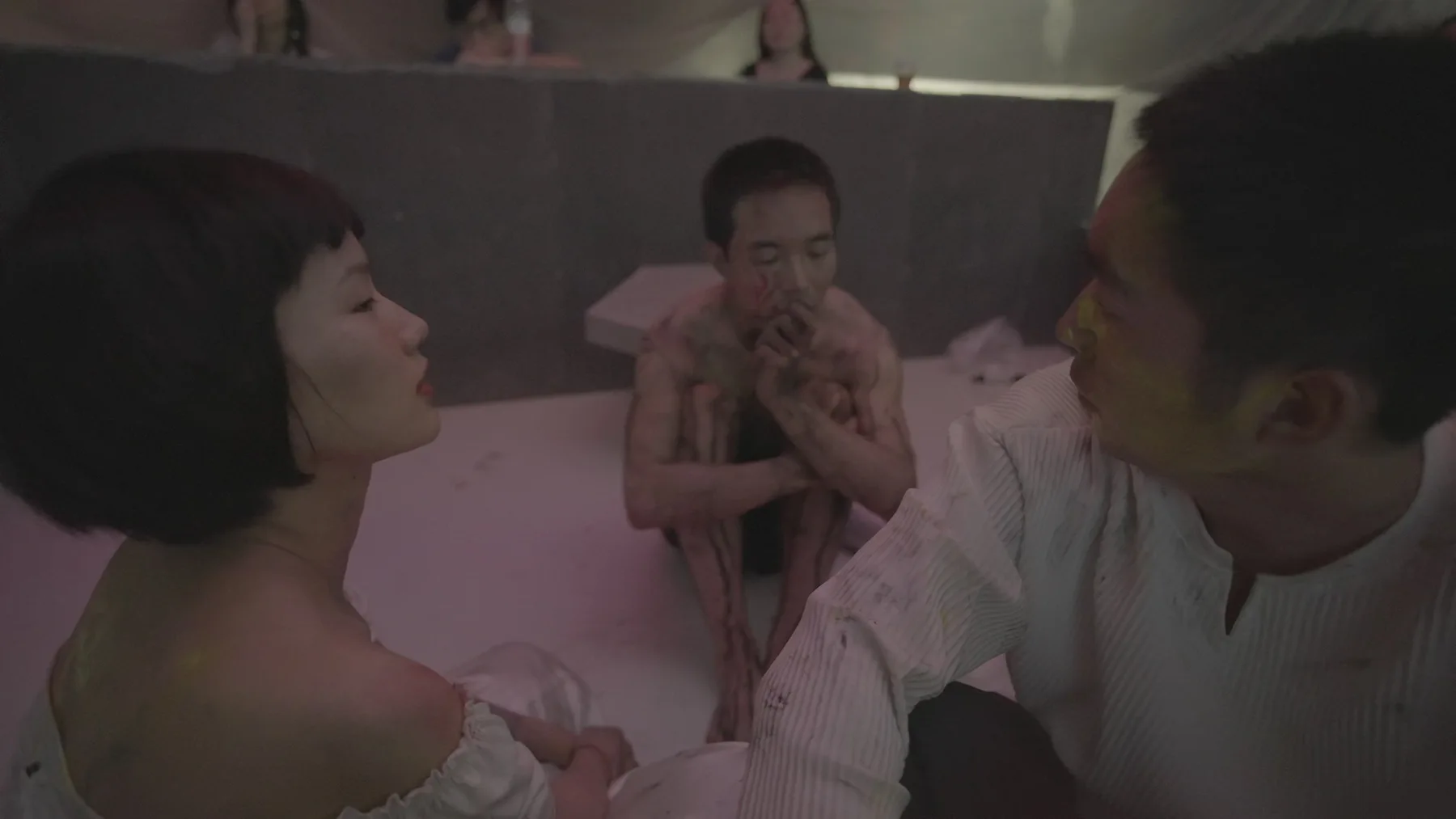
Intimacy remains a field of several positions, not a sealed space for two. Film still from Shoot Self with You / Human Surrender.
5. Even Your Blank Stare Can Be Edited into Content
Only when the film reaches a public setting do some of its sharpest sentences emerge.
Someone says they were not thinking about anything. They were simply spacing out.
The event answers at once:
“If you are in a daze, what will everyone watch?”
The sentence should not be seized too early as a master key to the entire film. It becomes terrifying only after all that has come before: the positions, rehearsals, intimacies, sensory pressures, and failures of acknowledgment.
This is not a witty remark.
It is a public machine finally exposing its rule:
If you have no content, you can still become content.
If you make no statement, you can still become the object of someone else’s statement.
You say you are only spacing out; the event processes that blankness into something watchable.
Many people today know this fear intimately.
You fall silent, and someone interprets you.
You do not reply, and someone takes a screenshot of the nonreply.
You have no status to post, and someone names the fact that you have no status.
You say, “I wasn’t thinking about anything,” and the system asks: why weren’t you thinking? While you thought nothing, what was everyone supposed to watch?
In the present tense of the platform, even the absence of a status can be turned into a status.
Another sentence is sharper still:
“Do you need me to speak for you?”
The danger of this question is not that it must be malicious.
On the contrary, it may be an expression of genuine care.
Someone cannot find the words; another person offers to speak. This may be a form of tending, of holding someone up, of refusing to let them fall all the way through.
But the same gesture also harbors the possibility of takeover.
When one person’s blankness is taken up by another voice; when another mouth says “I”; when the white fabric covers a face while speech grows denser; when a brief “Say it” opens a long passage of delegated speech—we can no longer classify the act neatly as either help or violence.
It resembles one of modern life’s most truthful ambiguities:
Care and possession often use the same hand.
Understanding and substitution often use the same mouth.
Human Surrender does not demand a crude prohibition against speaking for anyone else.
It demands something harder: after speaking for another person, continue to acknowledge that their blankness does not belong to you.
A person may be held up, but no one may sign in their place.
“Say it” may allow the process to continue for a while. It cannot be inflated into “You have fully authorized me to become you.”
Blankness can be preserved.
It cannot be possessed.
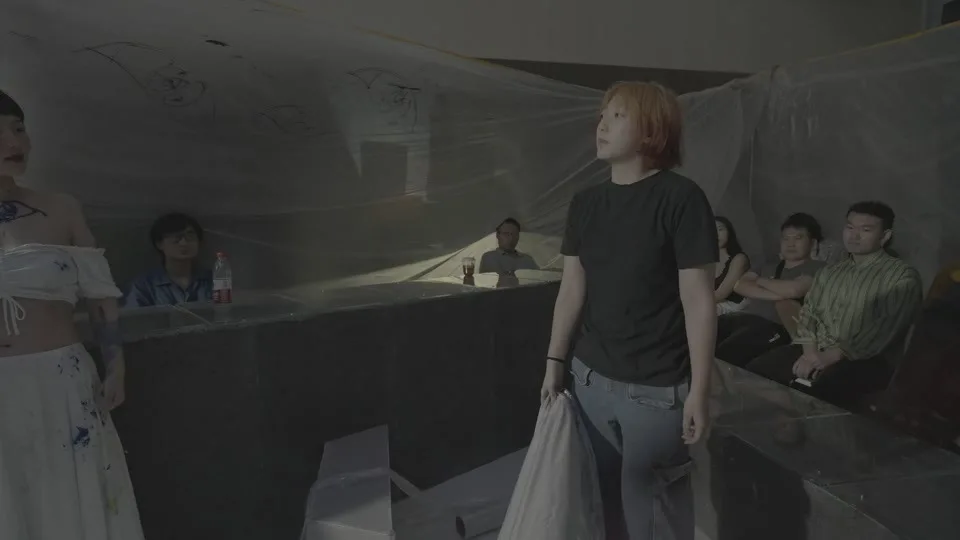
White fabric, a standing body, and spectators occupy the same visible field. Film still from Shoot Self with You / Human Surrender.
6. The White Fabric Does Not Block the Gaze. It Makes the Gaze Hurt More.
When the white fabric appears, much becomes difficult to see.
The face recedes into a shape.
The body becomes fold, swell, covering, and translucent surface.
We appear to enter invisibility.
The film immediately tells us otherwise. Invisibility is not disappearance.
The camera remains.
The audience remains.
The subtitles remain.
The sound remains.
The archive will remain.
“No one can see you” is therefore not a fact. It resembles a fantasy of safety spoken under the least safe conditions of visibility.
This is also one of the modern subject’s most familiar paradoxes.
We want to retreat into invisibility—to withdraw from work, relationships, platforms, explanation, and judgment. But invisibility can itself be recorded: offline status, unread messages, duration of silence, failure to update, failure to answer, failure to appear.
Even disappearance can become legible data.
Human Surrender does not show us simply that a person cannot be seen.
It reaches a more painful layer:
When visibility becomes an overload, a person longs to become invisible.
But invisibility, too, can be produced, named, and preserved by the event.
Now we arrive at the sentence in the title.
Don't complete me.
Not because I need no one.
Because I need a form of closeness that does not carry me away.
I need you to see me without turning sight into ownership.
I need you to hear me without turning hearing into finishing my sentence.
I need you to be there without turning presence into occupation.
7. The Credits' Cruelest Cut: The Film Finally Stops
The greatest achievement of Human Surrender is not that it drives the event to maximum intensity.
It is that, at the end, the film knows it cannot keep demanding things from living people.
The credits certainly archive.
Names appear.
Roles appear.
The production team appears.
Locations appear.
Special acknowledgments appear.
The audience, too, is thanked.
All of this matters. What happened must be preserved. Those who participated must not be erased. Spectatorship cannot pretend that it stood outside the event.
At the same time, the credits concede that no list can bring the event back whole.
A name is not a return home.
An acknowledgment is not an absolution.
Entering the audience into the archive does not give the audience interpretive sovereignty.
An archive is not a way of owning people.
At last, the sound recedes. In the darkness, only a logo and faint words remain. The film does not require its figures to keep speaking, its director to keep explaining, or its audience to keep extracting another expression.
It stops.
Many works push themselves until nothing remains unexpressed. Let the character say one more thing. Make the audience cry one more time. Give the creator one more round of explanation.
What is rare in Human Surrender is that it still has the power to continue and yet holds back.
The entire film has demonstrated a frightening talent for continuation. It keeps filming, keeps questioning, keeps turning failure into material, keeps pushing blankness toward sound, keeps transferring the event from one carrier to another. Its capacity is immense. That is precisely why the final act of stopping carries ethical weight.
True resistance to Instrumentality is not the destruction of the machine.
It is the admission, while the power to continue remains, that possession must not continue.
Here lies the deepest divergence between Human Surrender and Evangelion.
Evangelion stages Instrumentality as an apocalyptic temptation: if being human hurts too much, dissolve every boundary.
Human Surrender responds: precisely because being human hurts so much, no act of understanding, looking, archiving, or loving may carry a person away whole.
8. To Surrender Is to Stop Telling the Whole Person
The title Human Surrender should not be read literally as an admission of defeat.
Its surrender is not directed toward an enemy.
It yields to a fact:
No person completely owns the conditions under which they appear.
When you enter the light, you enter another person’s gaze.
When a camera preserves you, you travel toward the eyes of the future.
The sentences you speak will be received, misreceived, retold, excerpted, and archived.
You have loved, hurt, performed, fallen silent, and stared into space. These things truly happened, but once they appear, they no longer belong to you alone.
The reverse is equally true.
What happened to another person does not belong to you either.
You may approach, but not carry them away.
You may bear witness, but not complete them on their behalf.
You may preserve, but not mistake preservation for possession.
This is surrender in its deepest sense:
I concede that I cannot fully own my own appearance.
I also concede that I cannot fully own yours.
I will no longer pretend that I can be completed.
Nor will I use love, theory, spectatorship, recording, or understanding to complete you in the shape I desire.
9. For Those Who Still Remember Evangelion: The Cockpit Has Dispersed
If you still remember Evangelion—
if you remember the shame, fear, and loneliness of the boy being sent into the cockpit—
if you remember the seduction of Instrumentality, the promise that at last no boundary would separate one person from another—
then Human Surrender does not ask you to leave Evangelion behind.
It asks you to recognize that today’s cockpit no longer looks like a cockpit.
It may be a relationship.
A rehearsal.
A running camera.
The sentence “I’m listening.”
The sentence “Do you need me to speak for you?”
An essay determined to explain a film completely.
An act of understanding that is earnest, generous, and dangerous all at once.
The title’s appeal is not a rejection of the world.
It draws a harder and more precious boundary for the world:
Don't complete me.
Do not turn my silence into evidence of your depth.
Do not turn my pain into proof of your capacity to understand.
Do not turn my failure into fuel for your work.
Do not turn my blankness into your first person.
You may see me.
You may come close.
You may remember that I truly happened.
But at the decisive moment, please stop.
Let me happen for real.
And let me remain beyond your possession.
I am not saying that people should refuse intimacy.
I am saying that intimacy cannot make another person the place where the self finally comes home.
Nor am I saying that people should refuse to look.
I am saying that looking cannot pretend it has no hands.
Preservation is not the problem either.
The question is whether, after preserving, we can still remember one sentence:
It happened, but it does not belong to us.
Don't complete me.
Let me remain here, incomplete.
Watch and Continue
- Start with the new six-essay guide to Human Surrender.
- Watch the full film, Shoot Self with You / Human Surrender, with English subtitles.
- Explore the English criticism collection.
- Open the official film page and stills.
Evidence Boundary
This essay compares recurring formal and thematic structures in Neon Genesis Evangelion and Human Surrender. It uses Evangelion as a distant structural reference, not as evidence for facts inside Human Surrender. “Human Instrumentality Project” is the standard English name for the franchise concept; “Instrumentality” is used here as critical shorthand. The comparison does not claim that the television ending, The End of Evangelion, and the Rebuild films present one identical event or continuity. No Evangelion dialogue or image appears in this essay.
The four quoted lines from Human Surrender were checked against the owner-confirmed Chinese T0 role corpus and the published English CC master F1riPOyQuCI-English-merged-v2.srt. “Are you there?”, “I’m here.”, and “If you are in a daze, what will everyone watch?” follow the released cue wording, with punctuation normalized. “Do you need me to speak for you?” is a modernized publication rendering of 嗯 需要我帮你说吗; the released cue uses archaic English (dost … speak for thee).
All four images are P4 Theater film stills, not Evangelion images. The essay’s readings of dialogue, performance, spectatorship, and the archive do not establish the participants’ private motives, consent, off-screen relationships, harm, authorization, or production responsibility.