本篇目录 / Contents
- A Film Without an Outside: The Referential Contract of Human Surrender
- 1. The First Sentence Is Not an Opening. It Is a Capture.
- 2. Love Is Not a Feeling. It Is a Debt.
- 3. “Fake” Is Not an Answer. It Is a New Trial.
- 4. Even Spacing Out Does Not Let You Leave the Image
- 5. “I Don’t Want to Say” Still Stands—but It Cannot Stop the Film
- 6. The Credits Do Not Clear the Stage. They File the Evidence.
- 7. The Alien Is Not the First Question
- 8. The Spectator Has No Outside Either
- 9. The Final Question Is Not “Is It True?” but “Who Still Gets to Decide How They Become Real?”
- Evidence Boundary
A Film Without an Outside: The Referential Contract of Human Surrender
The easiest way to misdescribe Human Surrender (Shoot Self with You) is to call it a film in which truth and fiction become impossible to tell apart. Rehearsal stops looking like rehearsal; actors stop looking like actors; the director stops looking like a director; war stops looking like war; even “humanity” no longer appears as a subject that was securely established in advance.
That formulation sounds sophisticated, but it lets us off too easily. “Impossible to tell apart” still imagines two intact territories, reality and fiction, separated by a border that the film has merely blurred. It also preserves a comfortable position for the viewer: we stand outside the confusion, looking in, congratulating ourselves for recognizing ambiguity.
The film is more radical than that.
Its central question is not whether something is real or performed. It asks how anything acquires the standing of reality in the first place. Who addresses whom? Who is watching? Who names what has happened? Who is required to answer? Who may speak for another person? Who is entered into the credits, and who remains outside the record even after appearing before the camera?
I call the structure produced by these questions the film’s referential contract.
A referential contract is not a signed agreement. It is the unstable set of conditions under which an image, a sentence, a role, or a person becomes eligible to count as something: a confession, a performance, a memory, a piece of evidence, an expression of love, a refusal, a character, an actor, a human being. The contract is made in real time by cameras, bodies, voices, spectators, subtitles, names, and records. It can be revised without warning. It can be enforced without any single authority clearly owning it.
Human Surrender does not explain this contract from a safe distance. It makes the viewer enter it.
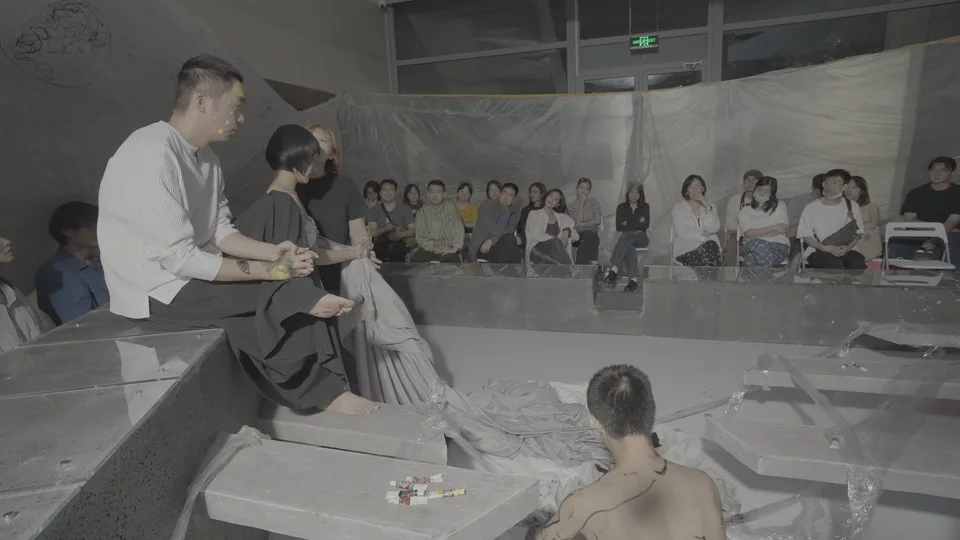
The live site holds performers, spectators, stage surfaces, and the camera in one field. Film still from Human Surrender / Shoot Self with You.
1. The First Sentence Is Not an Opening. It Is a Capture.
The film begins with a question:
“What brings you here?”
This is not merely introductory dialogue. It establishes an address before it establishes a world.
A conventional opening first tells us where we are, who these people are, and what situation they occupy. Only then does dialogue begin to organize relations among them. Here the order is reversed. A “you” is called into being before the scene has granted us a stable map of who possesses that pronoun.
The sentence therefore does several things at once. It implies a prior relation. It treats arrival as an event requiring explanation. It assigns the person who asks a temporary right to question, and the person addressed a temporary obligation to answer. Most importantly, it makes presence itself accountable. You are not simply here; your being here has become something that must be explained.
The reply is equally forceful:
“I had to see you.”
“I had to” does not name a preference. It names necessity, although the film does not supply that necessity with a single stable source.
When the sentence returns later, the image has changed: two people face one another while Zichou watches from behind. That altered image is not a license to reassign the line to a different speaker. The local sound source remains stable; what changes is the pressure of looking. A question that first seemed to pass between two people is now received by a third position of attention. Its repetition does not reveal a purer original. It shows that a line has no final force apart from the conditions of its replay. The words remain the same while the field of address around them changes.
This is the first operation of the referential contract. The film does not begin by showing us a reality. It begins by placing someone under address, then by making us answerable for having watched.
2. Love Is Not a Feeling. It Is a Debt.
At one point the film asks:
“Who can give me love?”
The ordinary romantic answer would be a person. The film refuses that simplicity.
Love here passes through a camera and through talk of footage, a kiss scene, the fourth act, and who controls the lighting. What might have remained an inward feeling becomes something that can be staged, recorded, replayed, interpreted, and judged. The question is no longer simply whether one person loves another. It becomes: who may recognize an act as love, and what conditions must be met before that recognition counts?
This is why the film’s apparently direct exchanges never remain private:
“Are you there?”
“I’m here.”“I love you.”
These lines arrive amid a sequence that seems to move outward and soften: going outside, being alone, “Are you there? / I’m here,” “I love you,” the moon, and the promise of being “always there.” Yet none of these words creates an actual exterior. Going outside does not mean leaving the film. Being alone does not mean leaving the relation. Even the moon cannot remain a stable elsewhere once it has been spoken inside this field.
Each sentence seems to complete a circuit between speaker and addressee. Yet the camera opens another circuit around it. “I’m here” verifies presence for someone inside the scene, but it also preserves that verification for the recording. “I love you” may be addressed to a character, an actor, a person behind a role, the camera, or the future spectator who will decide what kind of sentence it was.
Love thus becomes a debt not because it is insincere, but because it is made answerable to several incompatible witnesses. The speaker owes the addressee an answer. The performer owes the scene a legible act. The recorded image owes the future an account of what happened. The spectator owes the image an interpretation while lacking the right to settle it once and for all.
Even the Jiarui/Xu Jinjiang naming sequence matters. A name is not merely a label attached to a person who already stands intact outside the scene. Within the film, it can pull someone into a role slot: who is being addressed, who is expected to answer, and who will be held to that answer. This does not settle anyone’s real-world identity. It shows that names do more than point. They allocate positions and distribute responsibility inside the work.
By the end of this opening movement, the film has already laid down much of its argument: “you” calls a person into a position; love calls a debt into being; the camera calls forth a future viewer; a wrong name opens a role slot; the moon names a distance that fails to become an outside.
The film’s answer is not that love is fake. It is that love, once spoken before a camera, enters a referential contract that neither speaker nor addressee controls alone.
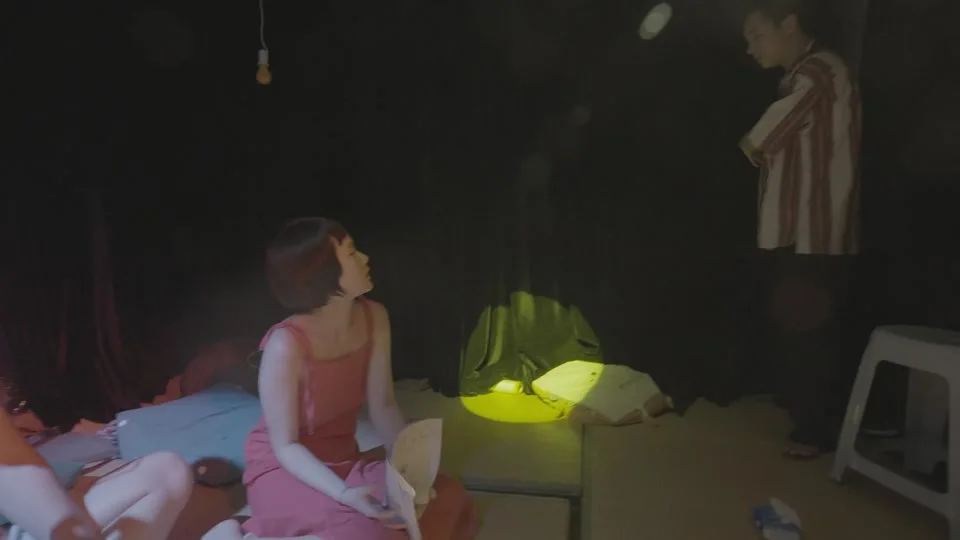
Going outside, being alone, and even invoking the moon do not create a clean exterior. Film still from Human Surrender / Shoot Self with You.
3. “Fake” Is Not an Answer. It Is a New Trial.
A sentence recurs like an accusation:
“So you think this is all fake?”
It sounds as if the film has finally named the problem. Perhaps everything we have seen is fabricated. Perhaps calling it fake will free us from having to decide what its scenes mean.
But “fake” does not end the trial. It opens another one.
The film immediately turns the judgment back on the judge:
“Do you dare to face what is real?”
The force of the question lies in its refusal to treat reality as a neutral substance waiting to be uncovered. The real is something one may not dare to see. It exerts pressure. It implicates the person who demands it. If the viewer insists on authenticity, the film asks what that insistence authorizes: more exposure, more access, more proof, more of another person made available for inspection.
Other lines intensify the trap:
“Yeah, this is a play.”
“What isn’t a play?”“This is all made up.”
None of these claims supplies an exit. They form a sequence of failed exemptions:
- Calling something false does not cancel the event of its appearance.
- Calling something real does not give us a stable object we may possess.
- Calling something a play does not establish a position outside performance.
- Calling something invented does not erase the consequences of the invention.
If a line was rehearsed, it was still spoken by a body at a particular time. If an emotion was performed, that performance still entered relations among people, camera, and audience. If a scene was fabricated, the fabrication still required labor, repetition, and exposure. If an image is evidence, it remains evidence produced under conditions the image itself cannot fully disclose.
The binary of true and false fails not because nothing is true, but because both terms are already embedded in procedures of address. “Real” and “fake” are judgments made by someone, about someone, for some future use. Each judgment changes the scene it claims merely to describe.
The film therefore offers no pure actuality behind the performance and no pure performance sealed off from actuality. There is no clean backstage where the referential contract is suspended. The moment someone says “this is a play,” that sentence itself becomes another act within the film—another bid to redefine what everyone has just seen.
4. Even Spacing Out Does Not Let You Leave the Image
One of the film’s most revealing exchanges begins with a claim of interior emptiness:
“I wasn’t thinking of anything.”
“Just spacing out.”
It is an attempt, however modest, to reserve a zone unavailable to interpretation. Nothing happened inside. There is no thought to report, no intention to decode, no message to retrieve.
The response closes that refuge:
“If you space out, what will everyone watch?”
The line is comic, but its logic is severe. Under the camera, even the suspension of action becomes content. To withdraw from performance is to produce the image of withdrawal. To offer nothing is to give “everyone” something to watch.
The word “everyone” is crucial. The scene is no longer organized only by those physically present. An indefinite public has entered it. This public may include the crew, an imagined audience, future viewers, or an institution of watching with no single face. Its demand precedes its arrival: if you are visible, you must provide something that can be watched.
Then the private interior is subjected to an even sharper claim:
“Your psychological monitoring report!”
A report translates interiority into a document. It promises that thought, mood, hesitation, or absence can be extracted from the person and made legible elsewhere. Whether such a report is serious, absurd, fictional, or theatrical matters less than the pressure the phrase exerts. The person’s claim—“I was thinking of nothing”—is no longer accepted as sovereign testimony about their own interior life.
This is not simply a film about surveillance. Surveillance assumes there is something hidden that a sufficiently powerful apparatus can reveal. Human Surrender is more unsettling: it shows the apparatus helping to produce the very object it claims to monitor. “Spacing out” becomes a performance because the camera and the anticipated audience require it to signify. The report does not merely discover a psyche; it gives the psyche an administrative form.
Under the referential contract, opacity is not automatically freedom. The refusal to mean can itself be assigned a meaning. Silence becomes material. Inaction becomes a scene. Absence becomes evidence of absence.
The film never allows us to forget the cruelty of that conversion.
5. “I Don’t Want to Say” Still Stands—but It Cannot Stop the Film
The words appear in two parts:
“I”
“Don’t want to say.”
The refusal is real as a refusal. Nothing in the film gives us the right to erase it.
Yet the film also shows why refusal cannot operate as a magic command that restores an untouched private realm. Once voiced, “I / Don’t want to say” has already entered the scene. It has become audible, recordable, quotable, and available for others to answer. The sentence protects a boundary while simultaneously making that boundary visible.
Another accusation follows:
“You left out a lot of words.”
The omitted words acquire a strange presence. They are absent, but their absence is named. The speaker is judged not only for what was said but for what was withheld. The film turns ellipsis into an item in the record.
The film then carries the refusal through a sequence of stone, Xu Jinjiang, a stele, and white fabric. The fabric covers the body, but it does not remove the body from the field of looking. Its broad plane and folds remain visible, as do the exit light, the audience, and the surface on which the figure lies. The wish for invisibility becomes an unmistakably visible arrangement. Concealment does not disappear from the image; it becomes the image’s organizing form. The covered figure is at once less available as a person and more forcefully present as a question.
Then Ameng asks:
“Do you need me to say it for you?”
Jiarui answers:
“Say it.”
This exchange must not be simplified into either perfect consent or pure coercion. The scene does not provide enough ground for either verdict. That single word marks the point at which delegated speech begins; by itself, it does not settle consent, authorization, or coercion.
Nor does the one-word response resolve ownership. Whose words are they once Ameng speaks them? Does delegated speech preserve Jiarui’s agency, displace it, or expose the fact that agency was already distributed across the scene? The film does not give us enough evidence to settle those alternatives.
The film does not invite us to decide by diagnosing the people involved. It asks us to attend to the structure. One voice becomes the relay for another. A refusal remains in force, yet production continues. Speech occurs without belonging cleanly to a single speaker.
Here the referential contract becomes most ethically demanding. A person’s “no” must not be overwritten, but neither can the viewer pretend that the word has restored an outside untouched by cameras, other voices, and future interpretation. The film continues around the refusal and, in doing so, makes visible the cost of continuation.
6. The Credits Do Not Clear the Stage. They File the Evidence.
Near the end comes a promise:
“No one can see you.”
In another film this might offer privacy or relief. Here the visible field contradicts the reassurance. The white fabric and its folds remain before us, together with the exit light, the worktable or stage surface, members of the audience, the camera’s position, and the subtitle that carries the promise. “No one can see you” is not a visual fact. It is a wish—and the film makes the wish sharply visible.
He Fa then announces:
“Thank you all.”
“For watching our performance.”
“Our performance is over.”
The words seem to restore ordinary theatrical order: there was a performance, there were performers, there was an audience, and now the event has ended.
But the ending refuses to stay ended.
The count of performers is corrected in public—three, then four, then five. A residual soundtrack continues after the declaration of an ending: science, the moon, deception, a toilet, bare feet, a door, a king. Elevated terms and low, bodily, everyday ones remain pressed together. The film does not clean them away. It lets them enter the credits.
Then come the visible entries “Starring Huang Meng,” “Starring Xu Shuai,” and “Starring Sun Jiarui.” These names are valid indexes; they help later viewers identify what the film records. But they are not final verdicts on identity. They do not appear on a newly purified black field. They are laid over afterimages of the live site: the audience, the white fabric, figures and layers, together with sound that has not yet fully withdrawn.
Cast and production team, shooting location, special thanks, the audience present that night, logos, and near-silence follow. The credits preserve not only performers but labor, place, witnesses, and people the film cannot entirely enumerate. Each addition appears to clarify what we have seen. Each also reveals that the previous account was incomplete.
Credits perform two contradictory operations.
First, they repair. They assign names to bodies, distinguish cast from crew, identify places, acknowledge labor, and offer the viewer a map back through the film. Without them, participation can vanish into the image without recognition.
Second, they leak. Every act of naming exposes what the list cannot fully contain. A person may appear under a role that does not exhaust them. A location may be recorded without explaining what occurred there. A production credit may acknowledge labor without settling responsibility. The corrected number of performers demonstrates that even the elementary question “Who was in this?” was never stable.
The credits are therefore not a neutral appendix. They are the film’s final scene of reference. The work attempts to archive itself, and the archive reveals its own seams.
The performance may be over, but its consequences are only beginning. The credits transfer the scene from present encounter to future record. They decide what later viewers will be able to name. At the same time, the leftover sound and the successive corrections keep something from being closed by the record.
The archive is both a shelter and another trial.
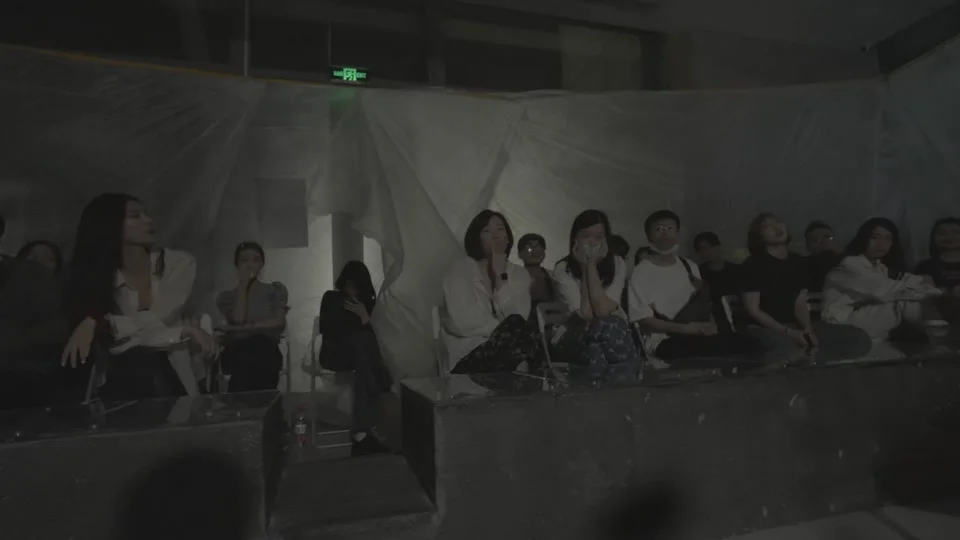
Spectators remain visible behind translucent fabric and beneath the exit light. Film still from Human Surrender / Shoot Self with You.
7. The Alien Is Not the First Question
The title and premise make it tempting to begin with science fiction. Who are the aliens? What do they want? Who represents humanity? What would surrender mean at the scale of a species?
Those questions matter, but the film places another question before them: who is the “you” to whom any declaration could be addressed?
Before humanity can appoint a representative, the scene must determine who can speak. Before anyone can surrender on behalf of others, the film must test whether one person can speak for another at all. Before the human can be contrasted with the alien, bodies must be recognized, named, watched, judged, and entered into a record.
The extraterrestrial premise thus magnifies an ordinary crisis of reference. Who is eligible to be called human? Who may stand in for “us”? Who is present when a statement is made? Who may judge that statement later? Who will be archived as participant, witness, performer, or audience?
The largest political category—humanity—depends on the smallest grammatical relation: I speak to you.
But in Human Surrender, neither pronoun stays put. “I” may be character, actor, speaker, delegate, or recorded trace. “You” may be beloved, scene partner, camera, absent person, alien, or future viewer. “We” may be a pair, a cast, a company, an audience, a species, or an institution assembled by the sentence itself.
The alien is not the first question because address precedes ontology. Before the film can tell us what kind of being stands before us, it asks what makes that being answerable to our gaze—and what makes our gaze answerable in return.
Surrender first appears not as defeat by a visible enemy, but as submission to a deeper cinematic arrangement: one must be addressed, watched, required to respond, and made to leave a trace. Love, refusal, silence, and a name all pass through other people, the camera, and the credits before they can be preserved at all. “Humanity” is therefore not a stable center. It is a position repeatedly called forth, questioned, entered into the record, and made unstable again.
8. The Spectator Has No Outside Either
The viewer’s favorite escape is interpretation.
We might say: it is all metacinema. Or a rehearsal. Or a documentary record. Or an allegory of surveillance. Or a love story contaminated by production. Or a science-fiction performance about humanity’s willingness to capitulate.
Each explanation catches something. None earns a position above the film.
To call the work metacinema is still to be implicated in the apparatus it exposes. To call it rehearsal does not tell us when rehearsal stops affecting the people involved. To call it documentary does not explain how recording reorganizes the event. To call it fiction does not remove the bodies and labor required to produce it. To call it an allegory does not cancel the specific voices, hesitations, obstructions, and names through which that allegory exists.
The film absorbs every explanatory exit back into its structure. We search for what is real, for the source of a voice, for who is performing, for who agreed, for who refused, and for whether the names in the credits can finally supply an answer. The spectator who declares “this is fake” becomes the addressee of “Do you dare to face what is real?” The spectator who retreats into formalism must account for the refusals that form helps make visible. The spectator who demands biographical truth discovers that the demand itself repeats the film’s pressure for disclosure.
This does not mean that real viewers are literally forced into the film’s plot. The claim is narrower and more exact: the film repeatedly makes the position of the watcher visible. Someone inside it asks, “If you space out, what will everyone watch?” The credits thank the audience who were there that night. Later viewers allow both sentences to happen again by returning to them.
There is no innocent way of watching. But that does not mean all readings are equal.
The absence of an outside increases, rather than abolishes, critical responsibility. We must distinguish what can be seen and heard from what we infer. We must preserve a refusal without converting it into proof of an unknowable private story. We must recognize a structure of delegated speech without declaring, from the safety of spectatorship, that we have solved the conditions under which it occurred.
The referential contract includes us. Our descriptions can clarify, distort, expose, shelter, archive, or overwrite. Watching is not ownership, and interpretation is not acquittal.
9. The Final Question Is Not “Is It True?” but “Who Still Gets to Decide How They Become Real?”
Across the film, reality migrates. Its route can be stated in ten movements:
- “What brings you here?” makes a person answerable.
- “Love” makes feeling available as something another person may be asked to give.
- The camera turns the present into material for future viewing.
- “Real,” “fake,” “play,” and “made up” deprive explanation of a secure outside.
- Spacing out turns private blankness into a public debt of visibility.
- The “psychological monitoring report” gives an interior state a readable administrative form.
- “I / Don’t want to say” allows refusal to remain in the record.
- “Say it” permits delegated speech to begin without erasing that refusal.
- “Our performance is over” renames the live field as a performance.
- The credits turn what remains into entries that can be preserved.
At no point does the film ask us simply to believe.
Its contract is not: Please accept that this is real.
It is: Watch something being made eligible to count as real.
That making has no single master. The camera does it by recording. The performers do it by addressing and answering. The scene does it by assigning roles. Sound does it by carrying voices beyond visible bodies. The audience does it by interpreting. The credits do it by naming. Future viewers do it by returning to a sequence whose participants could not fully control what their looking would become.
To surrender in Human Surrender is therefore not merely to yield to an alien force, a romantic partner, a director, a camera, or an audience. It is to enter a mode of reality-production with no secure outside. Everyone may affect the contract; no one can own it completely.
The film’s unsettling achievement is to make this condition perceptible without pretending to escape it. Its images do not reveal a pure truth behind performance. They show truth acquiring a form, a witness, a name, a cost, and a future.
This is the film’s deepest surrender: not to aliens, but to a way of producing reality that has no outside.
When the performance ends, the contract remains.
Evidence Boundary
This essay is a refined English translation and critical interpretation grounded in the film’s observable dialogue, images, sound, performance structure, and credits. Quoted English follows the available subtitle layer where locally attested. Where no exact English subtitle can be verified locally, the wording is an editorial rendering of the T0 Chinese line; “Do you dare to face what is real?” is one such rendering. The essay does not treat contested lines, gaze, gesture, names, credits, or formal details as proof of off-screen motives, private psychological states, consent, real-world identity, responsibility, or a literal science-fiction cosmology.
Watch the full film on YouTube
Enter the English criticism collection
If one moment stayed with you, leave its timestamp. A precise moment is a better beginning than a verdict.