本篇目录 / Contents
- What Would Make P4 Theater One of China's Most Experimental Theaters?
- Not Because It Is Stranger, but Because It Keeps Turning Itself into a Variable
- I. Chinese Experimental Theater Did Not Begin with P4
- II. The Unit of Experiment Is Not Strangeness but Revisability
- III. P4 Does Not Only Experiment with a Play; It Experiments with How a Play Comes into Being
- IV. More Media Do Not Matter; What Matters Is Whether Failure Can Migrate
- V. The Crucial Test: Did Failure Change a Rule?
- VI. P4's Potentially Distinctive Position: Structural Experiment, Not Isolated Invention
- VII. The Harshest Objection: Whom Is P4 Actually Experimenting On?
- VIII. “Most Experimental” Must Be Proven Again and Again
- References and Further Reading
- Evidence Boundary
What Would Make P4 Theater One of China's Most Experimental Theaters?
Not Because It Is Stranger, but Because It Keeps Turning Itself into a Variable
“P4 is one of China's most experimental theaters.”
That is a dangerous sentence.
Experimentality is not a prize, and China has no ranking that covers every independent theater, dance-theater collective, social-theater practice, and cross-media project. If this sentence is merely P4 praising itself, it fails the moment it is spoken. An “experimental theater” that cannot be questioned has little to do with experiment.
We should therefore not present the statement as an externally certified fact. We should turn it into a refutable judgment: first define what an experiment is; then place P4 under that definition and ask whether it can withstand the evidence of its own history, its failures, and its structure of power.
Our conclusion is conditional. If experimentality means novelty of stage form, the available evidence is not enough to establish P4 as a national leader. If it means that a theater repeatedly turns its media boundaries, distribution of roles, organizational methods, records of failure, and versions of its own history into revisable variables, then P4 is a strong case that deserves serious comparison within contemporary Chinese experimental theater.
The decisive question is not whether P4 is stranger. It is whether P4 can be rewritten by the results of its own work.
I. Chinese Experimental Theater Did Not Begin with P4
Any argument about P4 must first acknowledge a history longer and more complicated than P4 itself. In 2015, the Ming Contemporary Art Museum in Shanghai presented Thirty Years of Experimental Theatre, an exhibition that looked back from the early 1980s to 2015 through 88 works and approximately 125 hours of moving-image material. Danny Yung, Lin Zhaohua, Mou Sen, Zhang Xian, Wen Hui, Paper Tiger Theater Studio, Grass Stage, and the New Workers Art Troupe appeared within three intersecting lines: experiment, body, and society. That historical field is already enough to show that Chinese experimental theater was never an empty road waiting for P4 to arrive.
Meng Jinghui, Wen Hui and Living Dance Studio, Grass Stage, Paper Tiger, and Wang Chong with Théâtre du Rêve Expérimental do not each represent a single, sealed path. Their practices cross the body, society, the moving image, organization, and circulation. Even this finite sample is enough to establish clear precedents for interaction, improvisation, nonprofessional participation, material drawn from lived reality, live photography, work across media, and social intervention. P4 cannot claim any of these methods as its own invention. The histories of Meng Jinghui and China's contemporary avant-garde, Paper Tiger's use of life material and social performance, and Wang Chong's experiments with “stage movies” make any simple claim to being “the first” untenable.
This essay therefore does not argue from isolated invention. It asks whether P4 has connected existing experimental devices into a long practice chain that can be traced, challenged, and modified by its own outcomes. P4's defensible claim is not that “only we have done these things.” It is narrower and harder: once these methods enter the same sustained chain of practice, has P4 changed the unit of experiment itself?
II. The Unit of Experiment Is Not Strangeness but Revisability
A performance can look radically avant-garde. Actors move among the spectators. Images cover bodies. The director recedes from view. Audience members are invited onto the stage. A script is generated in real time. But suppose every possible response can be interpreted as proof of success: cooperation proves that the apparatus worked; resistance proves that it touched reality; silence proves that a character was repressed; departure proves that the work reached its limit. In that case, the performance has not submitted itself to an experiment at all.
It has built a meaning-machine that cannot lose.
A genuine experiment requires at least three things. First, the outcome cannot be completely written in advance. Second, failure must be capable of showing that the original method does not work. Third, failure cannot merely give the artist more material; it must have some chance of changing the conditions of the next attempt.
We call this capacity structural experimentality. Formal experiment alters the language of a work. Structural experimentality places the system that produces the work under experiment as well: who is recruited, who sets the rules, who holds the camera, who observes whom, who decides what happens next, who owns a version, who can stop material from circulating, and who writes the history after the performance is over.
Structural experimentality has four levels. The first is formal variability: text, body, space, sound, and the relation between performer and spectator change. The second is media variability: theater, photography, film, writing, and the archive translate one another. The third is organizational variability: the positions of initiator, performer, spectator, recorder, observer, and director are no longer treated as naturally fixed. The fourth is not “variable rights,” but constrainable power: the initiator's control over recording, editing, publication, archiving, and closure can be limited by those affected, and their refusal or withdrawal has enforceable consequences.
The first three levels determine the density of a theater's experimentation. The fourth determines whether that experimentation has political meaning.
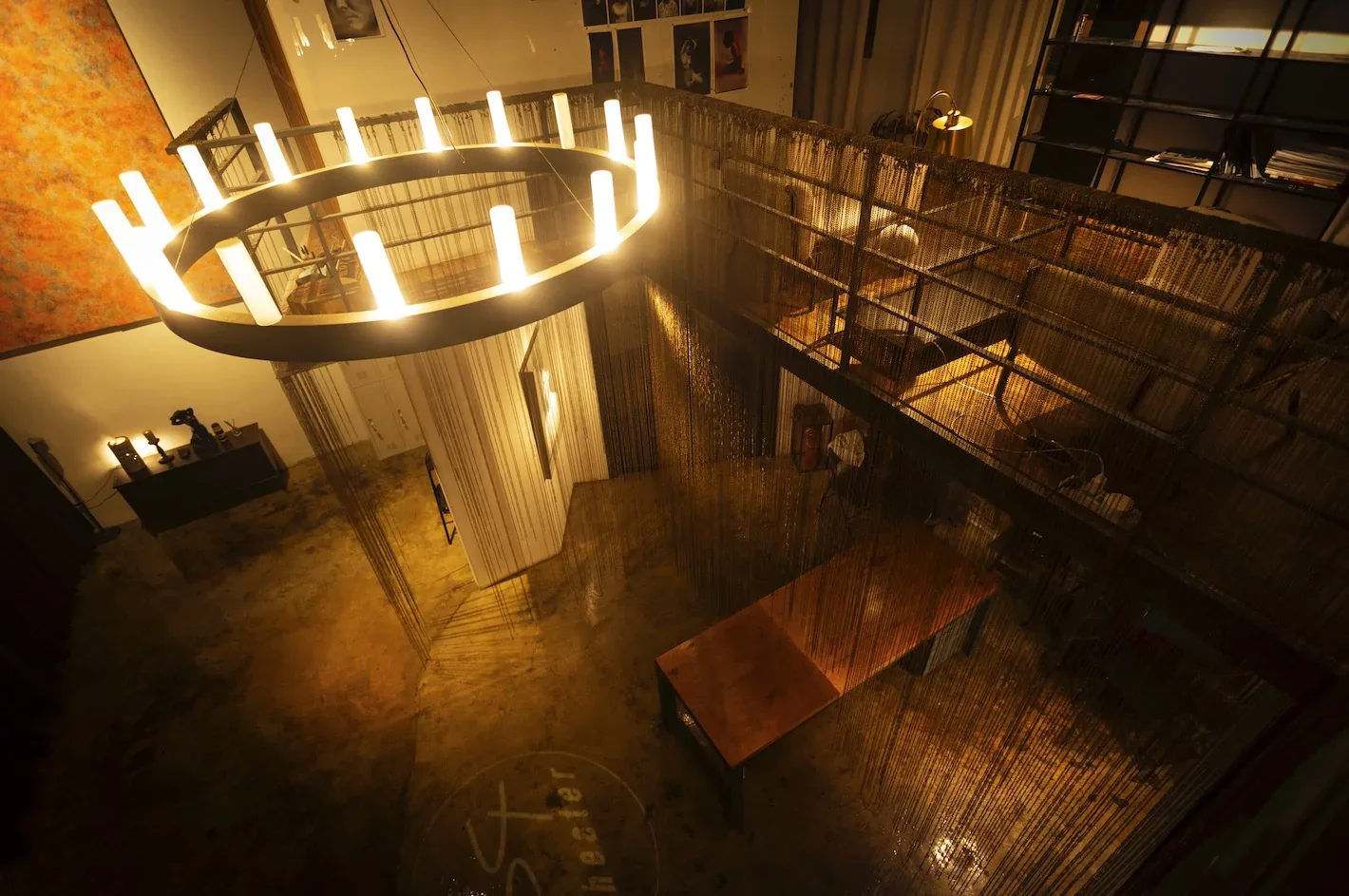
P4 Theater's space seen from above. The image documents a spatial arrangement; it does not by itself establish how roles or power were distributed. Courtesy of P4 Theater.
III. P4 Does Not Only Experiment with a Play; It Experiments with How a Play Comes into Being
P4 later traced the beginning of its construction to 2015. The earliest public node that can currently be checked against an external report is its public opening in June 2016. The report does not offer a convenient single-founder story. It says that Zhang Shaohua originally built the stage for photography, and that Ao Shuang (傲霜) and He Fa jointly planned the opening performance, Shadow Counterpoint (影子对位法). White veils, projections, background sound, repeated commands, bodily conflict, and the reporter's own impulse to intervene appeared in the same account. This evidence establishes at least that P4's early space held photographic facilities and theatrical events at once. One opening report cannot, by itself, prove that photography and theater had already formed a stable, mutually generative system; later projects and version records are still needed. The 2016 account nonetheless leaves P4 with a clear obligation: respecting its experimental history means refusing to compress a complex origin into the myth of a single author.
Later public calls placed entrants in many possible positions: performer, player, spectator, deliberator, photographer, witness, recorder, or initiator. That proves that P4 designed multiple positions of participation. It does not prove that one person could move freely among them, or that interpretive authority, control of materials, and decision-making power moved with the role. A call for participants is not merely promotion that happens before a show. It begins to specify how an action will occur: who may initiate, who must respond, who can observe, who will be recorded, and who is entitled to interpret the process.
Many experimental theaters experiment with a work. P4 has repeatedly experimented with how a work is produced.
Real Image organized one-to-one encounters, photography, looking, and parting into a project mechanism. p4U attempted to connect an outside initiator, P4's support, and 3P observation, documentation, and feedback in a new creative structure. Purple Action wrote decisions, deliberation, and voting into its interactive rules. The public recruitment text for Human Surrender placed three elements inside one project proposal: long takes and game-like rehearsals in an enclosed space; a photographer entering performers' lives to build a material database; and an actual public performance designed by the performers and shaped through interaction with the audience. By Last Rehearsal, theater, performance art, sound, installation, audience interaction, and filming throughout the event were publicly connected, while the live event was declared part of a film.
These materials reliably show that P4 repeatedly made the unit of production a public question. Whether that unit actually changed in practice must still be tested project by project against run sheets, live recordings, participants' accounts, and differences between versions. In P4's public designs, a play extends across recruitment, rehearsal, the live event, photography, post-event writing, film, and archive. How fully that chain operated in each project remains a separate evidentiary question.
P4's most important work may not be any single evening's performance. It may be this production chain, repeatedly dismantled, reassembled, and recorded.
IV. More Media Do Not Matter; What Matters Is Whether Failure Can Migrate
Cross-media work is not rare in itself. Putting a screen onstage does not automatically make a new theater. Filming a performance may add nothing more than another distribution format. The real question for P4 is whether a problem that one medium cannot solve forces the practice into another medium—and changes how later work is organized.
Photography at P4 does not only preserve a performance; it can change who looks and who is looked at. Theater does not only provide a setting for photography; it brings apparently stable relationships into action and conflict. Film does not only edit the live event; it compresses rehearsal, everyday life, performance, backstage time, and future spectators into another temporality. P4's WeChat publications are not only promotional; they carry recruitment, dispute, post-performance response, and methodological explanation. Later archives and theories then rearrange which people, failures, and projects count as P4's history.
P4 has thus produced a recognizable circuit:
Recruitment → rehearsal → live event → photography/documentation → post-event text → film/archive → later interpretation → the next call.
In the previously compiled dual-account corpus covering 2016–2025, 705 P4 posts were successfully parsed: 304 categorized as theory and method, 165 as recruitment and transformation, 92 as activity and performance, and 37 as controversy and declaration. Projects including Real Image, Cocoon, Duel Club, Howlers on the Rooftop, Human Surrender, and Purple Action have clusters of public texts rather than isolated announcements. These figures do not prove how many people P4 changed. They do not prove equality inside the organization. They establish something narrower and more reliable: P4 left an unusually dense first-party experimental log in which recruitment, failure, dispute, project branching, and retrospective interpretation did not all vanish after the curtain call. P4's current public definition still presents live events, relations, participation, action-generation, and its article archive as parts of one practice system.
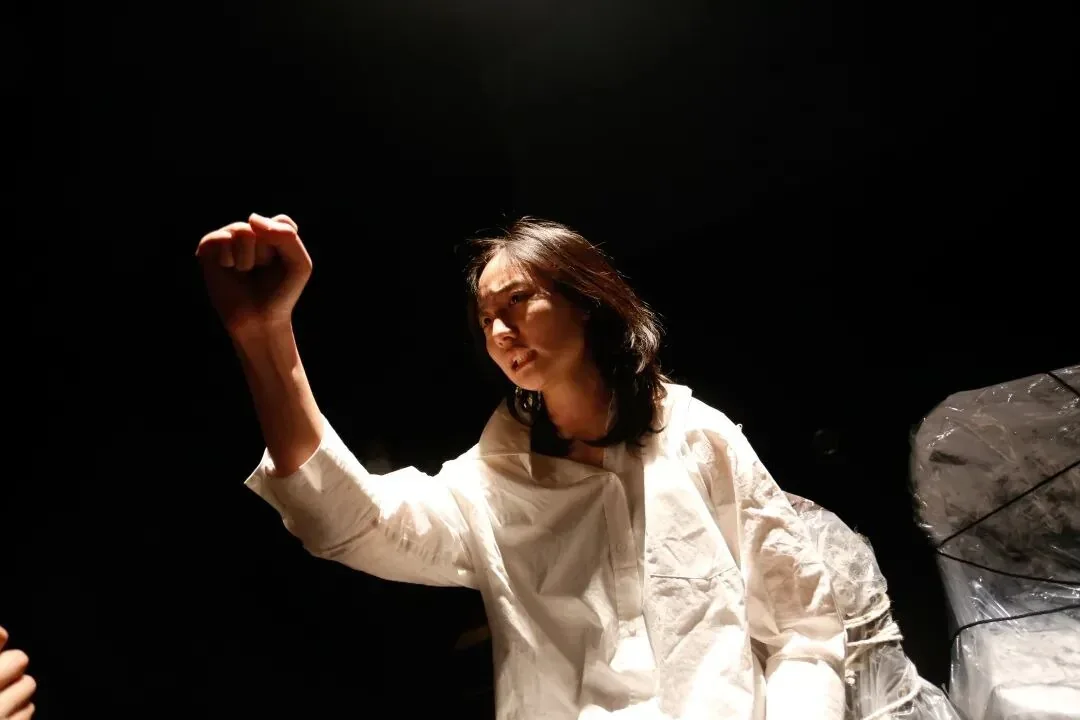
A performance image from Howlers on the Rooftop in P4's project archive. One image can document a project scene; it cannot demonstrate the organizational relations behind it. Courtesy of P4 Theater.
Documentation does not complete an experiment. But without documentation, failure is easily covered by the next success.
V. The Crucial Test: Did Failure Change a Rule?
The strongest public evidence now available that P4 allowed failure to alter the next organizational design appears in a 2020 text introducing p4U after Displace. This first-party account records a Bluetooth failure at the end of the performance, a principal creator losing control during the post-show discussion, and a failed submission. It then uses explicit causal language to connect those experiences with p4U and proposes a structure of “outside initiator + P4 support + 3P observation, documentation, and feedback.”
This is rare and valuable evidence because it does more than say, “We grew from failure.” It makes a difference between the organization before and after failure visible. Technical, relational, and distribution failures were not entirely hidden backstage; they became part of the stated rationale for new roles and an observation mechanism.
But the evidence must not be made prettier than it is. P4's public p4U rules still reserved final interpretive authority, producer/presenter authority, and sales authority for P4. There is a real tension between “not interfering with the initiator's creation” and a center retaining final powers. Recording failure does not resolve failure. Adding observers does not give participants decision-making authority. The document proves that P4 wrote failure into an institutional attempt; it does not prove that decentralization was achieved.
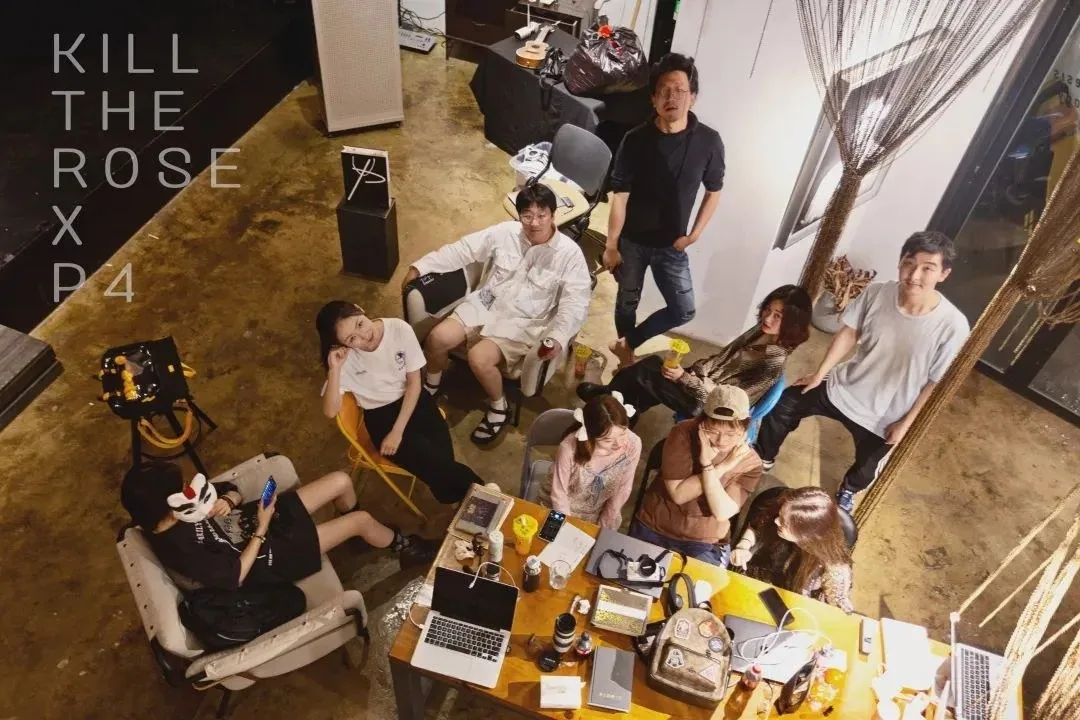
P4's local project manifest identifies this image with Kill the Rose, a p4U project. The photograph records a gathering and its equipment; it does not assign roles, authority, or consent. Courtesy of P4 Theater.
This is the line separating experiment from self-packaging. Publicity may compress contradictions, and theory may close them too quickly. The minimum responsibility of an experiment is to let unresolved contradictions continue to constrain the next practice.
If failure only gives the artist more stories, it is extraction. Failure becomes experimental knowledge when it makes the old rules impossible to continue unchanged.
VI. P4's Potentially Distinctive Position: Structural Experiment, Not Isolated Invention
Our finite sample is not sufficient to rank P4 nationally in stage form, bodily research, social organization, or live cinema. Nor does this essay try to reduce radically different practices to a single scale of strength.
P4's potentially distinctive position lies elsewhere. It has compressed experiments that are often separated into different lineages into a decade-long practice history with identifiable archival supports: forms change; media change; participants' positions change; structures of initiation and observation change; space and brand split apart; failure becomes public; a film attempts to summarize and even terminate the theater; then the theater reappears in articles, websites, and archives.
P4 experiments not only with a play, but with an entire process through which theater acquires reality, turns reality into material, reorganizes that material, and sends it back into the next round of reality.
This is what we mean by structural experimentality. It does not score a theater by the number of media it uses, but asks whether those media exert causal pressure on one another. It does not count how many people were invited, but asks whether a participant's position can change. It does not count how many reflections were published, but asks whether reflection changed a rule. It does not ask whether an organization is brave enough to fail, but whether failure can make the organization lose its original plan.
Within the limits of this essay's sample and the available evidence, P4 displays a high degree of structural experimentality and therefore qualifies as a strong candidate for the proposition “one of China's most experimental theaters.” That remains a critical proposition, not a national ranking. To make the case stronger, P4 must still pass the harshest test.
VII. The Harshest Objection: Whom Is P4 Actually Experimenting On?
P4 may not be experimenting with theater. It may be experimenting with the people who enter the theater.
Participants contribute bodies, lives, intimate relations, emotions, conflicts, failures, and departures. P4 acquires images, works, articles, archives, methods, reputation, and theory. If participants keep changing while the directorial position, account control, final cut, publication rights, and the power to name history remain concentrated, P4 reproduces a crucial part of platform logic: the edges keep supplying feedback while the center retains rule-making, value extraction, and historical interpretation.
Platforms also record feedback and update themselves in response to people. They make users continuously adapt while withholding from those users the power to decide what the system remembers, what it forgets, and when it stops. If P4 edits every objection into a film, turns every departure into proof that the work reached its limit, and metabolizes every ethical criticism into more complete theory, recursion becomes only a more intelligent machine for digesting critique.
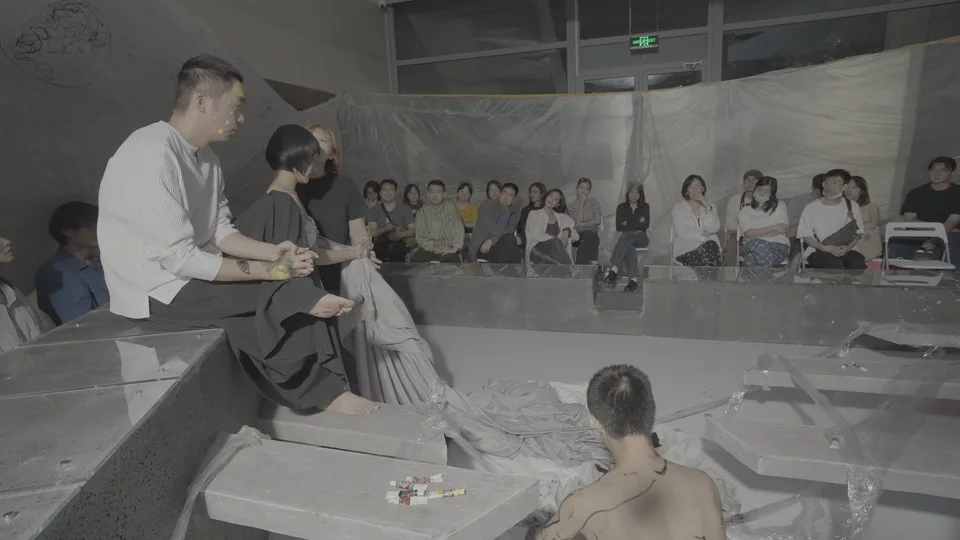
Performers, spectators, stage surfaces, and the camera occupy one live field in Human Surrender / Shoot Self with You. The image does not prove shared authority, authorization, or consent. Film still courtesy of P4 Theater.
The political threshold of structural experiment is therefore not whether a director is willing to reflect on himself. It is whether those who bear the consequences can constrain the conditions of the next round. Which objection changed a recording protocol? Who acquired the power to stop a performance, demand a re-edit, veto publication, or withdraw material? Which refusal truly remained outside the work? When did failure make P4 lose footage, a version, a resource, or an original plan? Can a person who left retain an account in the archive that differs from the initiator's?
The public evidence does not yet answer these questions in full. P4's self-documentation proves a willingness to discuss failure. It does not prove that shared final cut, material withdrawal, the right not to be made into a work, revenue distribution, or archival access has become a stable institution.
If the only thing that keeps changing is the participant while the creative institution never changes, then the theater is not experimenting with itself. It is experimenting with others.
Participants should not be the test subjects. The institution producing the pressure should be.
VIII. “Most Experimental” Must Be Proven Again and Again
We can now offer a conclusion with an edge, but without fabricating consensus.
P4 is not the beginning of Chinese experimental theater, nor the endpoint of every experimental lineage. It did not invent lived reality entering the theater. It did not invent nonprofessional participation, live photography, cross-media work, interaction, or social intervention. P4 qualifies as a serious contender for the description “one of China's most experimental theaters” because it has done something harder to summarize through any single production: it has repeatedly pushed the conditions of theatrical production into view, drawing space, roles, cameras, audiences, initiators, recorders, films, articles, archives, and P4 itself into one circuit that might be rewritten by the next result.
This does not mean that P4 is the most correct, the most equal, or the most advanced. The capacity to experiment can even increase a system's ability to extract life, absorb dissent, and update itself. A genuinely radical experiment must go further: those affected must acquire the power to rewrite conditions, limit materials, and end the circuit.
The title is therefore not a medal to be collected today. It is a responsibility that every future project must assume again: did failure change a rule? Did dissent constrain power? Did refusal make the work truly lose material?
Whether P4 deserves to be called “one of the most experimental” will not finally be decided by this essay. The next time someone says no, P4's structure will provide the evidence. If the camera closes, the material leaves, and the version changes, the claim survives. If nothing stops, the title fails.
References and Further Reading
- “Thirty Years of Experimental Theatre”: experiment, body, and society across 88 works
- MCLC review: Meng Jinghui and the “pop avant-garde” lineage of contemporary Chinese experimental theater
- 2016 report on P4's public opening and Shadow Counterpoint
- P4 Theater's public definition and article archive
- Grass Stage and documentary/social theater: Nanjing University lecture material
- Living Dance Studio and the Folk Memory Project: UCCA project material
- Paper Tiger Theater Studio: public introduction
- Wang Chong on stage movies and experimental theater
- The 2020 p4U account: from the failures of Displace to an observation-and-feedback structure
- The 2023 public recruitment text for the film Human Surrender
- The 2023 public-performance text for Last Rehearsal
Watch Human Surrender / Shoot Self with You
Read the English Human Surrender essay collection
Subscribe to P4 Theater on Substack
Evidence Boundary
“One of China's most experimental theaters” is a falsifiable critical proposition, not an award, industry certification, or exhaustive national ranking. The comparative sample is finite and does not cover every Chinese experimental-theater practice. P4's first-party archive supports claims about public self-description, recruitment, stated rules, project genealogy, and the density of its own documentation; it does not independently prove equality, social impact, uninterrupted operation, shared final cut, stable withdrawal mechanisms, or the implementation of every published rule. Structural experimentality is the author's T3 critical term. Project images document visible spaces and scenes but do not prove identity, role distribution, authorization, consent, power-sharing, or political effect.